



Building the engine behind the shift to SGP.32 IoT eSIM for scale
Building the engine behind the shift to SGP.32 IoT eSIM for scale

- Publish Date: July 24, 2026
Kigen
- Publish Date: July 24, 2026
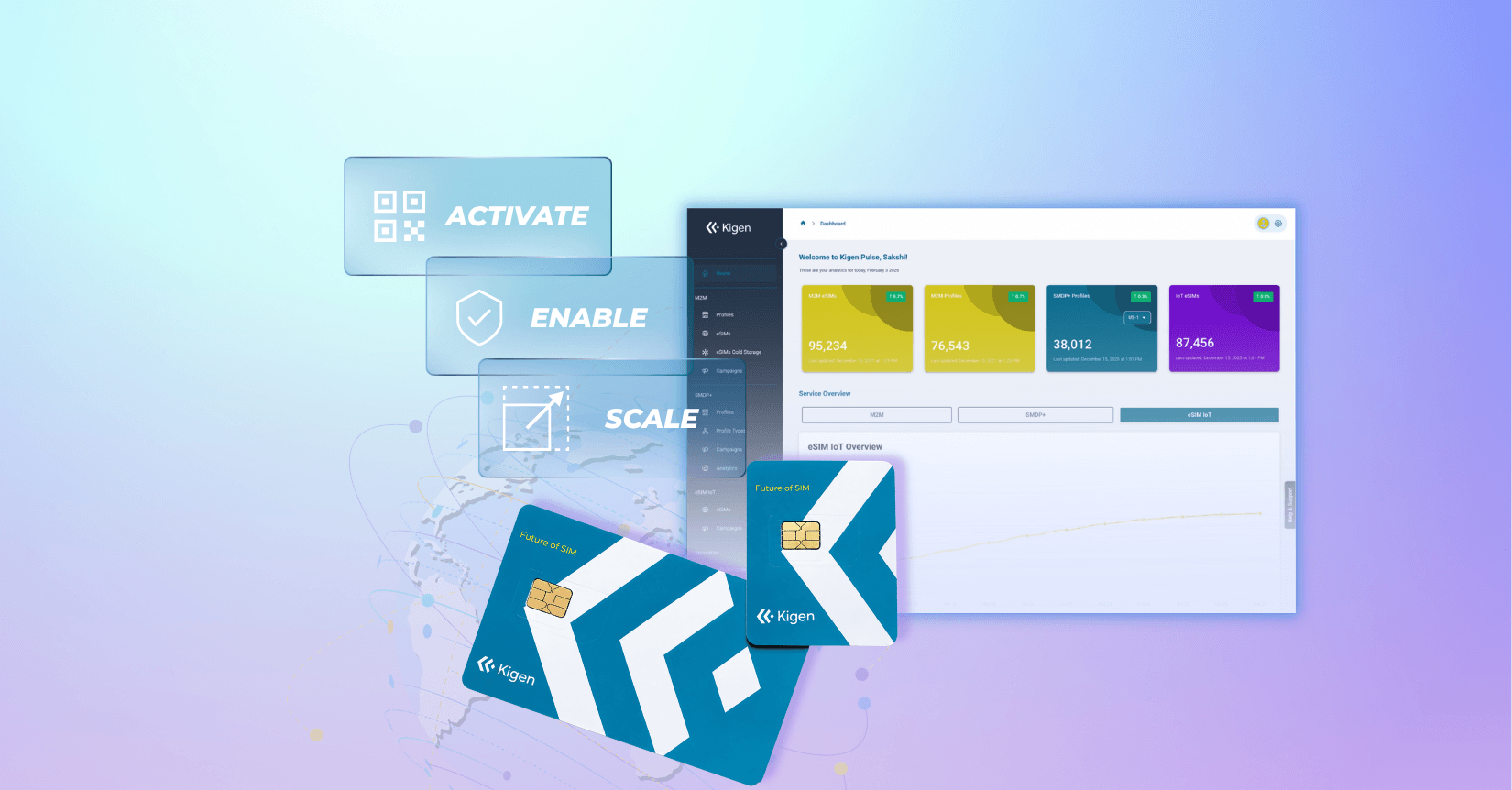
Kigen is opening access to its IoT eSIM Starter Kit for qualified businesses ready to test secure, scalable eSIM activation and remote SIM provisioning in real-world conditions.
––––
The Kigen IoT eSIM Starter Kit brings together 10 certified Kigen eSIMs, access to Kigen eIM and Kigen Pulse, device-side development tools including C-SDK and IPAd, three months of evaluation access, and profiles from 13+ participating connectivity partners ready for activation on Kigen eSIM.
Several more MNOs and MVNOs are finalizing their streamlined profile activation workflows with Kigen, extending the growing ecosystem for businesses that want the freedom to choose connectivity while maintaining a single, consistent eSIM foundation. The starter kits are also compatible with hundreds of MNO profiles that have already been tested for download, which can be sourced separately.
For manufacturers, OEMs, ODMs, embedded developers, and enterprise IoT teams, the launch marks a practical step forward: a simpler way to test SGP.32 IoT eSIM management before moving into pilot, fleet operations, or production-scale deployments.
The SGP.32 standard is ready. Scaling with it is the harder part.
SGP.32 is ready. That is only half the story.
The GSMA IoT eSIM standard gives businesses a new way to manage cellular profiles remotely across connected devices, including devices that may be constrained by power, network availability, cost, or the absence of a user interface.
There are also certified eSIMs, eIMs, device tools, and individual network providers adopting the new model. That is another important part of the story.
But anyone who has built, deployed, or scaled connected products knows the deeper challenge. Turning remote eSIM management into transformational business outcomes requires more than individual components. It requires the right eSIM technology, the right management environment, the right device-side integration, the right connectivity partners, and the confidence that those pieces work together.
Kigen is proud to have played a leading role in the collaboration that resulted in a standard addressing IoT needs at scale, with Dr. Said Gharout, Kigen’s Head of Standardization, also supporting the specification as the Chair of the eSIM Working Group at the GSMA.
Is the SGP.32 ecosystem ready? If anyone was ever in doubt, it is ready now. That is what Kigen has brought together in the IoT eSIM Starter Kit.
Why businesses need breadth in connectivity choices
Many IoT businesses do not operate in one simple network environment.
A manufacturer may already be set up with one connectivity provider but needs another for diversification into a new sector. An enterprise may need multiple networks for operational resilience. A device maker may need to expand into regulated markets where local connectivity requirements, coverage, commercial terms, or profile availability differ. A global product team may need to support customers in different regions without redesigning hardware or multiplying SIM supply-chain complexity.
The business need is clear: freedom to choose connectivity without rebuilding the entire operating model each time.
Without a unified route, teams often spend time establishing separate relationships with each vendor, aligning activation processes and the burden of integration and maintenance across stack layers, validating profile downloads, testing device behavior in response to each, handling EIDs, resolving exceptions, and making sure the different parts of the stack work together.
The Kigen IoT eSIM Starter Kit removes that friction. We started with asking what needs to happen if the ease for which the standards were designed is to seamlessly translate into product portfolios and become a foundation on which next generation of intelligence is built.
It gives businesses a trusted starting point where fully certified Kigen eSIMs, remote management, device-side tools, and activation-ready partner profiles come together in a single practical evaluation environment.
13+ connectivity partners ready for activation, with more preparing to join
At launch, the Kigen IoT eSIM Starter Kit includes profiles from 13+ participating connectivity partners , ready for activation on Kigen eSIMs.
This matters because SGP.32 value depends on choice. Businesses need to evaluate which connectivity options fit their products, regions, customers, compliance requirements, and operational priorities. A single provider may be right for one deployment. Multiple providers may be needed for resilience, expansion, or customer-specific requirements. For each of these pioneering connectivity providers, each interaction is a starting point at which their service, support and simplicity can delight and win new global businesses.
Kigen’s role is to help make that choice easier to adopt and easier to scale.
By working closely with participating partners, Kigen and its partners have validated the activation experience, enabling businesses to achieve meaningful outcomes faster. This cohort is leading in this capability and serves as a starting point, with more MNOs and MVNOs expected to finalize their workflows in the coming months. Partners that are ready with secure digital profiles offering activation today: 1oT, flo LIVE, Hologram, iBASIS, KDDI Spherience, KORE, Monogoto, Nuvo Linq, Onomondo, Pangea, Semtech, Skylo, Soracom and Zariot.
This focus on digital secure profile activations strengthens the streamlined routes for IoT connectivity with AT&T Business, Vodafone, China Mobile International, and other partners. This connectivity activation also extends with Kigen eSIMs being interoperable and fully tested with Secure with Kigen, whereby Kigen eIM supports over 60 IoT modules and platforms from leading IoT module vendors. Businesses can also request that their preferred connectivity provider be included in the digital activation program as the program expands.
Built on learnings from 18 months and 100 journeys of eIM platforms moving into products
The Kigen IoT eSIM Starter Kit builds on the company’s established eIM trials, gaining pace across the past 18 months, being adopted and working towards scale into connected product roadmaps. The 100+ journeys have given eSIM experts at Kigen direct insight into how unified eSIM management flows meet the realities of field deployment.
Those realities include constrained devices, different module environments, network variation, platform-specific integration work, operational exceptions, onboarding requirements, and the practical steps needed to move from proof of concept into full production. Digi International, Evergy, FloLIVE, Itron, NuvoLinQ, Robustel and other major brands in industrial systems, smart meters and smart trackers as well as wearables, and automotive have announced scaling and expanding with SGP.32 IoT eSIMs from Kigen.
The Kigen IoT eSIM Starter Kit and the team’s deep partnership with participating connectivity providers benefit directly from those learnings. The aim is to simplify what businesses have historically had to piece together themselves: activation flows, remote management, partner coordination, device-side readiness, and the operating model needed for scale.
A simpler model for open IoT eSIM access
The shift in the scale for which SGP.32 was materialized comes into sharp focus as intelligence is increasingly applied to edge systems, industrial equipment, meters, payment terminals, vehicles, and autonomous systems operating in the physical world.
“Intelligence is becoming distributed, giving IoT a critical role in how businesses innovate with AI,” said Vincent Korstanje, CEO, Kigen. “As connected systems become more capable and autonomous, their connectivity must be managed with the same discipline and ease as enterprise software. The Kigen IoT eSIM Starter Kit, together with our connectivity partners, gives embedded product developers a consistent foundation to build, deploy, and scale intelligent products across the physical world.”
From first activation to full-scale operating confidence
Full-scale operations require more than a singular event of successful profile download. This is why the kit features 10 eSIMs to start with, and full set of eSIM enablement tools for device-side integration and an API-rich environment, fine-tuning device config, exception handling, and strategizing a clear path from evaluation to pilot and production.
The Kigen IoT eSIM Starter Kit gives businesses three months to test that operating model in real-world conditions.
Teams can use the kit to evaluate profile activation, remote profile management, network resilience, high availability, fine-grained device-level control, and the operational reality of managing connectivity at scale.
The value is confidence: confidence that the standard is ready, the profiles are available, the partners are aligned, and the hard work of testing and validating the activation environment has already been advanced by Kigen and its ecosystem.
“Businesses want the benefits of SGP.32, but they also need a simple and trusted way to start,” said Jean-Louis Carrara, SVP Sales at Kigen. “They want to know which profiles are available, how activation works, including what unified flows support the reality of their own field deployments. By launching with 13 participating connectivity partners, and with more providers preparing their workflows, Kigen is helping create a practical model for open IoT eSIM access. Customers can now focus on outcomes without having to assemble the entire ecosystem themselves.”
For OEMs and manufacturers, it can reduce the friction of designing connected products for multiple markets. For ODMs, it can support more reusable device designs. For enterprises, it can make it easier to evaluate resilience, provider choice, lifecycle control, and expansion options before committing devices to the field.
Start with Kigen. Activate with choice. Scale with control.
The shift to SGP.32 will be defined by whether businesses can use it to move faster, reduce risk, and maintain control of connected products after they ship. That is possible now. The Kigen IoT eSIM Starter Kit brings certified eSIM technology, remote management, device-side enablement, partner choice, and real-world evaluation access into one starting point.
For the businesses building the next generation of connected and intelligent products, it offers a clearer path to secure IoT at scale. Request your kit today

New Podcast Episode

Building Real-Time Voice AI Experiences

Related News
Proton's Lumo AI Adds Encrypted Canvas for Documents, Code and Interactive Web Pages
October 26, 2026

Sensera Systems Announces SiteCloud 2.0 to Speed Decision Making and Improve Project Outcomes
October 22, 2026
Abitronix and Iveda Target New York Tri-State Expansion with AbitronixAI, Powered by Iveda
October 20, 2026


Related Solutions

Service Intelligence for Auto Service Providers
Gain insights into bay utilization, crew performance, and improve customer satisfaction
Gain insights into bay utilization, crew performance, and improve customer satisfaction
Leverege
Leverege


Lot Management for Dealerships
Helping dealers with quicker theft recovery, more efficient reporting, and enhanced customer experience
Helping dealers with quicker theft recovery, more efficient reporting, and enhanced customer experience
Leverege
Leverege

Yard Management for Auto Manufacturers
Enabling workers to Instantly locate vehicles, reduce labor costs and better detection of bottlenecks to improve efficiency
Enabling workers to Instantly locate vehicles, reduce labor costs and better detection of bottlenecks to improve efficiency
Leverege
Leverege

Energy Monitoring for Grocery Stores
Helping retailers reduce and audit energy consumption while eliminating equipment downtime and lost inventory
Helping retailers reduce and audit energy consumption while eliminating equipment downtime and lost inventory
Leverege
Leverege

Inventory Visibility for Retailers
Equipping retailers with highly accurate inventory cycle counting to help increase sales and reduce theft
Equipping retailers with highly accurate inventory cycle counting to help increase sales and reduce theft
Leverege
Leverege

Related Solutions
Automotive
Service Intelligence for Auto Service Providers
Gain insights into bay utilization, crew performance, and improve customer satisfaction
Leverege
Automotive
Lot Management for Dealerships
Helping dealers with quicker theft recovery, more efficient reporting, and enhanced customer experience
Leverege
Automotive
Yard Management for Auto Manufacturers
Enabling workers to Instantly locate vehicles, reduce labor costs and better detection of bottlenecks to improve efficiency
Leverege
Retail
Energy Monitoring for Grocery Stores
Helping retailers reduce and audit energy consumption while eliminating equipment downtime and lost inventory
Leverege
Retail
Inventory Visibility for Retailers
Equipping retailers with highly accurate inventory cycle counting to help increase sales and reduce theft
Leverege