



IoT MVNOs: 290 Million Connections Managed in 2025
IoT MVNOs: 290 Million Connections Managed in 2025

- Last Updated: May 20, 2026
Kaleido Intelligence
- Last Updated: May 20, 2026

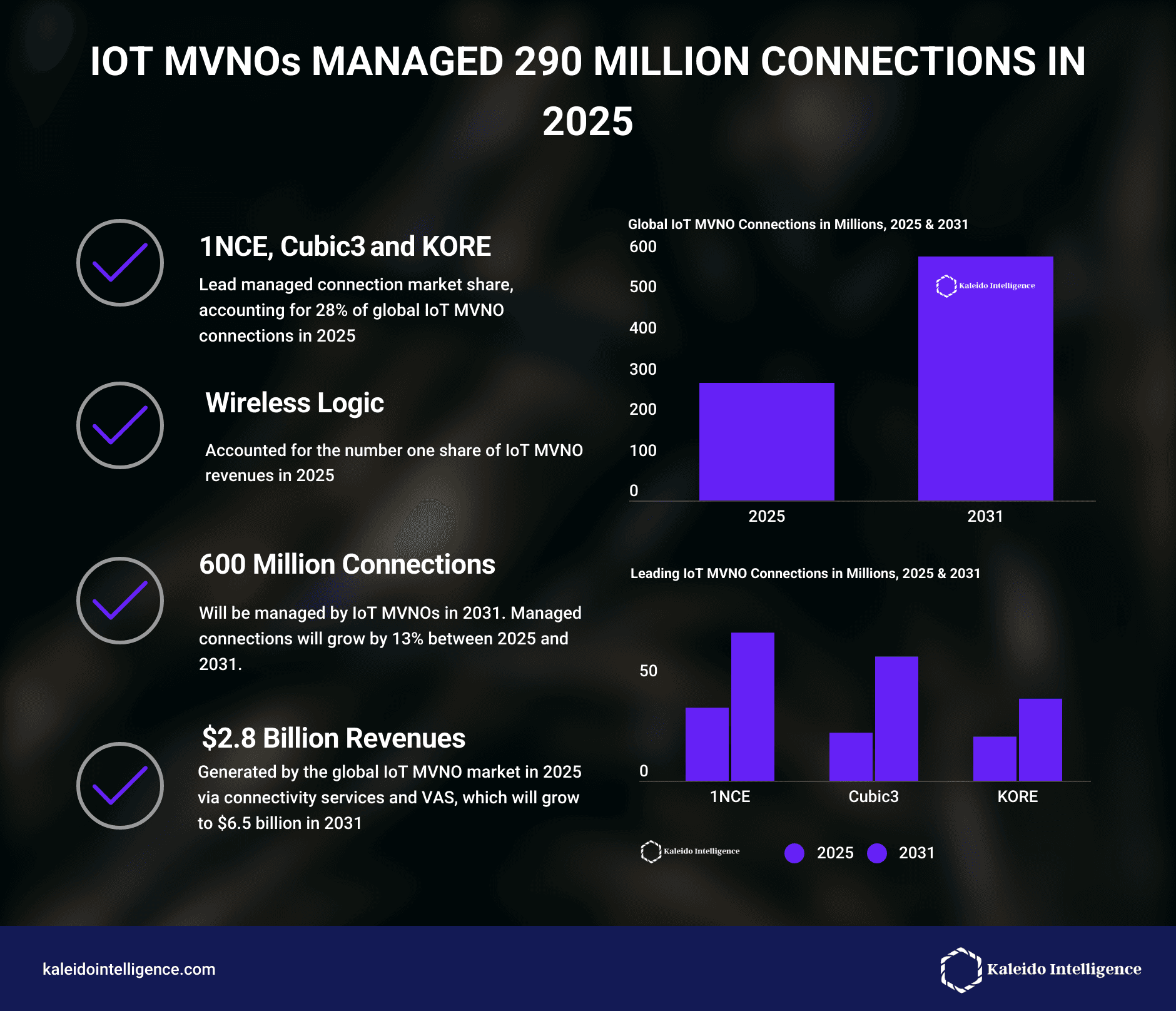
The IoT MVNO market grew to 290 million managed connections in 2025, having grown from 45 million in 2017. By 2031, Kaleido expects the total IoT MVNO market to reach 600 million connections.
1NCE, Cubic3 and KORE Wireless Top 3 IoT MVNOs
Today, there are three clear leaders in terms of connection volume: 1NCE, Cubic3 and KORE Wireless, with these providers accounting for 28% of global managed IoT MVNO connections. Each one of these players has a different story to tell in terms of their success.
On the one hand, we have 1NCE, the (in)famous MVNO behind the 10-year EUR10 flat-rate package. This attractive pricing model, combined with a strong roaming footprint, customer logistics and self-service onboarding has helped see the company grow at an astonishing average 58% growth in managed connections since commercial operations commenced in 2018. Today, a focus on infrastructure and development of advanced orchestration and management features aim to offset the challenging economics of low-bandwidth, low-cost connectivity, and it is evident that the company is increasingly seeking to deliver against mission-critical IoT business requirements.
Next up is Cubic3, which began as more of a horizontal IoT MVNO but has since focused on the automotive and heavy industry/agricultural segment. The vast majority of its managed connection base lies within the automotive segment, and today the company is laser-focused on delivering analytics and software solutions to enable customer monetisation. The term IoT MVNO is likely far from desired, despite the company’s innovative efforts in 5G and satellite connectivity. To date, investment from Softbank has realised limited success beyond traditional markets, although this is likely to change towards the end of the forecast period.
Finally, KORE Wireless, which has had some challenging years recently. Its acquisition of Twilio’s IoT business was not a smooth process, while the company’s focus has not always appeared cohesive. By Q3 2026, the company is likely to be under new ownership, thanks to an agreement with Searchlight Capital Partners and Abry Partners, which should, at the very least, relieve some of the pressure to perform on the NYSE. Meanwhile, the KORE One project hopes to realise a fully integrated customer experience and bring the company back on form.
Wireless Logic Leads IoT MVNO Revenues
While the three providers examined above may lead in terms of connection volume, there is a clear leader in terms of revenue. Here, the crown goes to Wireless Logic, which has sharply executed a strategy of in-house development and targeted acquisition to ensure that it is predominantly positioned to deliver against high-value segments. Value generation beyond pure connectivity is important here, and expertise in connectivity, devices, security, as well as application enablement, represent capabilities to reduce customer deployment friction. Additionally, the acquisition of Brazil’s Arqia looks particularly astute, with the country representing a high-growth market for the future.
Globally, IoT MVNOs brought in over $2.8 billion in connectivity and management revenues in 2025, and this is set to rise to $6.4 billion by 2031.
Shifting Market Dynamics Impacting Monetisation Potential
Overall, there are lingering questions over IoT MVNOs’ ability to both differentiate as well as effectively monetise operations. Enterprises are more reliant on IoT than ever, which leads to a realisation that the lowest cost connectivity might not be the best option, particularly where limited control and policy enforcement is exposed, with regulations and compliance now becoming a significant concern for players with multinational deployments. The ‘quick and easy’ model of the IoT MVNO utilising sponsored roaming and low-cost data plans looks to be constrained for the future.
Conversely, adding cutting-edge technology solutions is not always an open goal for new revenues and customer traction. Typically, value-added services made up single-digit proportions of players’ revenues in 2025, which can create potential challenges in terms of a return on investment, especially when a sales team is accustomed to selling connectivity, as opposed to value: reducing customer compliance overheads, identifying cost optimisations, and supporting emerging requirements in terms of performance, security and customer control are messages that do not translate as easily as offering a solution that undercuts a competitor. For pure resellers, the market looks challenging in terms of growth. For MVNOs invested in competing for more complex customer wins, competition is high, and the market is perhaps more challenging still. That said, the potential upside can justify the added complexity and risk.

The Most Comprehensive IoT Newsletter for Enterprises
Showcasing the highest-quality content, resources, news, and insights from the world of the Internet of Things. Subscribe to remain informed and up-to-date.

New Podcast Episode

IoT Is Finally Delivering

Related Articles




Related Solutions

Mobile Networking for Public Safety
Enable data sharing, enhanced situational awareness, and secure communication across vehicles, devices, and command centers.
Enable data sharing, enhanced situational awareness, and secure communication across vehicles, devices, and command centers.
Digi
Digi

Asset and Inventory Monitoring
Track assets, monitor performance, and maintain persistent connectivity to improve supply chain efficiency, security, and uptime.
Track assets, monitor performance, and maintain persistent connectivity to improve supply chain efficiency, security, and uptime.
Digi
Digi

Primary and Failover Connectivity for Retail
4G/5G cellular networks for enabling uninterrupted retail operations with seamless support and rapid deployment across stores.
4G/5G cellular networks for enabling uninterrupted retail operations with seamless support and rapid deployment across stores.
KORE
KORE

Related Solutions
Smart Cities
Mobile Networking for Public Safety
Enable data sharing, enhanced situational awareness, and secure communication across vehicles, devices, and command centers.
Digi
Supply Chain & Logistics
Asset and Inventory Monitoring
Track assets, monitor performance, and maintain persistent connectivity to improve supply chain efficiency, security, and uptime.
Digi
Retail
Primary and Failover Connectivity for Retail
4G/5G cellular networks for enabling uninterrupted retail operations with seamless support and rapid deployment across stores.
KORE