What Is UHF RFID? A Practical Guide for IoT Decision-Makers
What Is UHF RFID? A Practical Guide for IoT Decision-Makers

- Last Updated: March 18, 2026
Isaac Hayes
- Last Updated: March 18, 2026
Most of what gets written about RFID online reads like it was copied from a vendor slide deck. The same four talking points about "transforming operations" and "unlocking visibility," and none of them tell you the stuff that actually matters when you're trying to figure out whether this technology belongs in your facility. So let me try to do that instead.
The Frequency Thing Actually Matters
RFID operates across multiple frequency bands, and people gloss over this as a minor detail. It isn't.
Low Frequency (125-134 kHz) is your access cards and livestock ear tags. Works at a couple of centimeters, doesn't care much about metal or water, but it's slow, and you're reading one tag at a time. High Frequency at 13.56 MHz is NFC: phone payments, library books. Still short range, still mostly one-at-a-time.
UHF sits at 860-960 MHz, and that's where things get interesting if you're thinking about operations at any kind of scale. Hundreds of tags per second at distances up to 10 or 12 meters. You're not scanning items one by one anymore. You're reading entire carts, pallets, or rooms in seconds. That's the difference between a barcode replacement and a technology that actually changes how your operation works.
How It Works (Without the Sales Pitch)
Three pieces: tags, readers, and software.
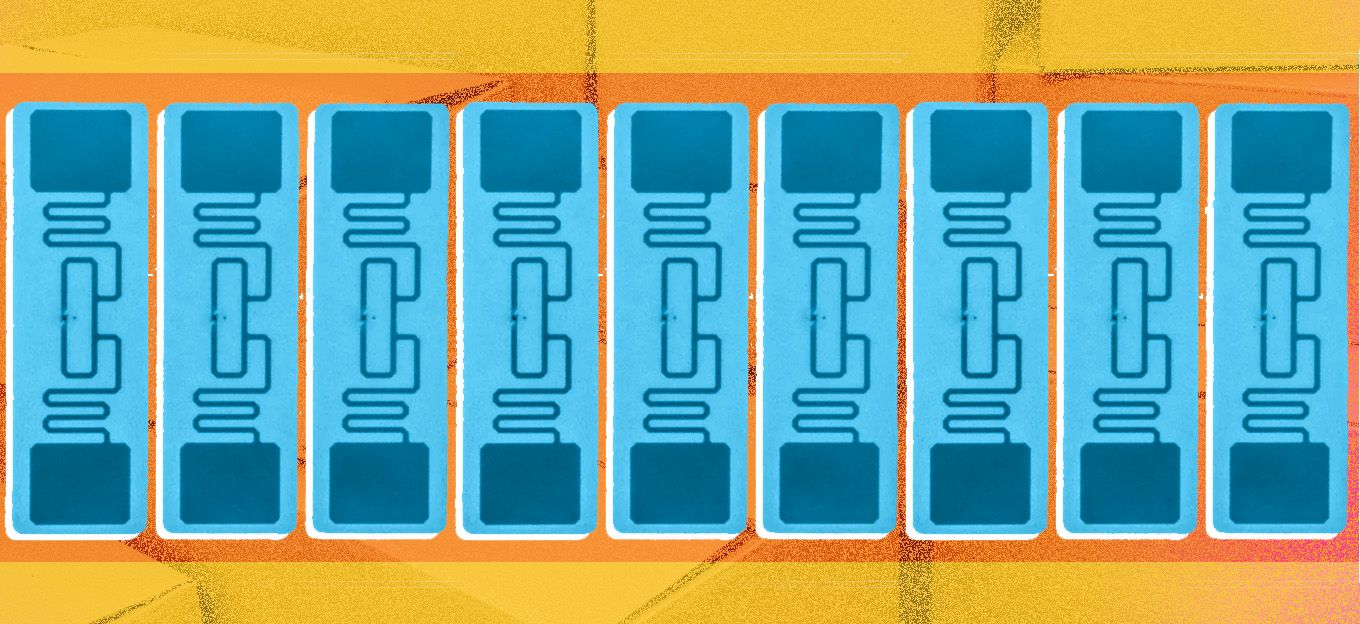
Tags are cheap. Most passive UHF tags cost cents because there's no battery in them. They sit there doing nothing until a reader hits them with radio energy, and they use that energy to shout back their ID. That's the whole trick. No battery means they last basically forever, which is why you can justify tagging individual towels or $3 parts.
Readers are the expensive bit. Fixed readers sit at doorways or conveyor transitions and watch everything that passes through. Handhelds let someone walk around and scan an area. The antenna determines the shape and size of the read zone, and this is where most of the engineering effort goes. Getting the zone right is genuinely hard.
Software is where I see the most underinvestment. A single reader can spit out thousands of tag observations per second. Most of those are noise. The same tag read 47 times in two seconds. Tags in an adjacent room are bleeding through the wall.
Tags on a cart parked near the read point but not actually moving through it. The software has to sort signal from noise, then translate raw reads into events your business systems can act on: "this pallet just shipped," "these items are missing from this delivery." That translation layer is where projects succeed or fall apart. It rarely gets the attention it deserves during planning.
Where People Are Actually Using This
Retail is the one everyone cites. Zara and Decathlon proved you can take store inventory accuracy from around 65 percent to above 95 percent, and that a full store count that used to take days with barcode guns takes hours with RFID handhelds. Those numbers have been validated enough times now that they're not really debatable.
Commercial laundry is the one I know best. Hospitals and industrial laundries embed UHF tags in textiles, and those tags survive hundreds of wash cycles through tunnel washers, dryers, and ironers. Before RFID, linen loss rates of 15-20 percent per year were just accepted as the cost of doing business. With RFID tracking through the whole circuit, that drops to 2-3 percent. On a million-dollar annual linen budget, the savings are hard to ignore. Surgical instrument tracking uses the same principle, though the stakes shift from cost to patient safety.
Manufacturing uses it for work-in-progress tracking, especially in high-mix environments where hundreds of different jobs move across dozens of work centers. Barcode-scanning every item at every station doesn't scale. RFID portals at key transitions give you production visibility without anyone stopping to scan.
Asset management is the quiet one. Tools, IT equipment, returnable containers, pallets. Organizations regularly discover 10-15 percent more assets than they thought after their first RFID audit. That tells you everything you need to know about how well manual tracking actually works.
What Goes Wrong
I've been working with RFID in commercial laundry, logistics, and manufacturing for close to a decade. The failure patterns are remarkably consistent.
People treat the vendor demo as evidence that the technology works in their environment. It doesn't tell you that. UHF radio waves bounce off metal, get absorbed by water, and behave completely differently depending on what surrounds them. A tag that reads at 8 meters in a demo room might read at 2 meters on your product, sitting on a metal shelf, surrounded by 500 other tags. You have to test in your actual facility with your actual items. I wrote a UHF RFID site assessment guide that covers the environmental factors worth paying attention to.
Then there's the barcode mindset. Barcodes are intentional: someone aims a scanner at a thing. RFID is ambient. The reader picks up everything in its field, whether you wanted it to or not. That's a fundamentally different data problem, and if you haven't thought about what reads matter versus what reads are noise before you start buying hardware, you're going to have a bad time.
The workflow problem is just as common. Deployments that deliver are the ones where someone sat down and rethought how work moves through the operation, given that automatic identification now exists at key points. The ones that fail bolted RFID onto a process designed around people scanning barcodes. Same workflow, more expensive equipment, marginal improvement.
And scope. People go too big. They try to roll out across the whole facility at once instead of picking one contained area, proving it works, measuring the before-and-after, and expanding from there. The wall-to-wall-on-day-one projects almost always end up with expensive hardware and disappointing results.
The Practical Stuff
Start with the problem, not the technology. "We lose $200K in linen every year" is a reason to investigate RFID. "We want RFID" is not. Walk your facility and figure out where automatic identification would actually change something: doorways, conveyor transitions, staging areas, and dock doors. Each of those is a candidate for a read point.
Spend serious time on tag selection. What you're sticking the tag to matters more than anything on the tag's datasheet. Metal, liquids, heat, chemicals, and mechanical abuse. Get samples from two or three vendors and test them on your real items in your real environment. Don't skip this.
Plan your integration early. The RFID system generates events. Those events need to reach your ERP, WMS, or whatever runs your operation. Figure out how that connection works before you buy hardware, because integration will probably cost more than the readers and tags combined.
On standards: UHF RFID has a mature ecosystem. GS1 EPC Gen2 (ISO 18000-63) means tags and readers from different manufacturers are interoperable, so you're not locked to a single vendor. RAIN RFID alliance certification is a reasonable baseline when comparing hardware. Regional frequency regulations vary (North America sits on 902-928 MHz, Europe on 865-868 MHz), but most modern readers handle multiple regions.
Where This Is Heading
Tags keep getting more sensitive, which means longer range with less power. Some now carry onboard sensors for temperature or moisture alongside their ID, which starts to blur the line between identification and condition monitoring. Cloud IoT platforms are making it easier to build workflow automation on top of RFID event streams rather than just logging reads to a database.
But the technology was already good enough five years ago for most use cases. What's still catching up is the understanding of what it takes to deploy well. The hardware works. The standards are solid. The gap is in the software, the process design, and the willingness to do a proper site assessment before writing purchase orders. Tag prices keep dropping. That gap isn't closing nearly as fast.

The Most Comprehensive IoT Newsletter for Enterprises
Showcasing the highest-quality content, resources, news, and insights from the world of the Internet of Things. Subscribe to remain informed and up-to-date.

New Podcast Episode

IoT Is Finally Delivering

Related Articles